
PK1Cloud in the Age of AI: Why Digital Infrastructure Gets Stronger, Not Obsolete

Listen to a podcast-style summary of this blog post

Durable Digital Infrastructure for Intelligent Insurance Operations

Some AI proponents argue that artificial intelligence will replace software as a service (SaaS). Others claim it will replace knowledge workers altogether. These predictions have rattled stock markets and sent shares of software and consulting firms sharply lower. But are they true?

AI is evolving at an extraordinary pace. New models arrive continually and capabilities expand month by month. Vendors rise, compete, and reposition, often promising to do nearly everything. In our view, the reality is more nuanced.

In the noise, it is easy to focus on the models themselves. But models will commoditize and rotate quickly. The durable advantage will come from what those models plug into: the underlying digital infrastructure.

AI creates sustained value only when it runs inside secure, structured, well-governed operational systems. Without that foundation, AI remains stuck in pilot mode. It may be impressive in demonstrations but inconsistent in production and risky at scale.

PK1Cloud was built for that reality.

We did not set out to build a standalone AI tool. We built an integrated operating platform. PK1Cloud is a secure, workflow-driven environment that manages the full lifecycle of insurance product development, filing, compliance, and reporting. That foundation enables our clients to adopt the next phase of intelligent automation, AI, without sacrificing control, traceability, or regulatory defensibility.

What PK1Cloud Is

PK1Cloud is an integrated analytics, product design, and compliance platform developed by Perr&Knight. It organizes the structured work required to design insurance products, prepare regulatory filings, respond to regulators, implement products operationally, and and compliance obligations over time.

The platform is intentionally agnostic about who performs the work. Inputs can come from internal teams, third-party consultants including Perr&Knight experts, and increasingly AI-enabled tools and workflows. PK1Cloud does not privilege the source of expertise. Instead, it structures the work, enforces governance, and preserves institutional knowledge.

At its core, PK1Cloud provides a common data model, defined workflows, controlled documentation, secure communications, and integration capabilities that connect regulatory systems, core platforms, rating bureaus, and third-party data sources. Where appropriate and advantageous, it also can connect to AI providers. Historically fragmented processes become unified, traceable, and governed within a single ecosystem.

That ecosystem is what makes AI deployable.

Practical Applications Inside the Platform

Consider a new regulatory filing. The workflow is structured, but much of the work is repetitive. Teams review prior filings, compile exhibits, populate standard fields, and assemble supporting documentation. Experienced professionals perform these tasks carefully, yet they often recreate patterns that already exist.

AI trained on historical filing inputs can work inside PK1Cloud to pre-populate templates, retrieve previously approved language, generate required exhibits, and validate completeness. Instead of starting from a blank page, teams begin with a structured first draft grounded in precedent. Human professionals move from manual assembly to oversight, judgment, and strategic refinement.

Policy drafting is another example. Compliant language demands clarity, precision, and a deep familiarity with regulator expectations. AI trained on historical approvals, state-specific requirements, and prior objections can propose draft language aligned with regulatory norms. Because drafting occurs inside PK1Cloud, every revision is version-controlled, every change is attributable, and every approval is auditable. This allows organizations to move faster without sacrificing governance.

The same pattern applies during regulatory review. Department of Insurance objections often follow recognizable themes. AI operating inside the platform can classify an objection, retrieve comparable historical responses, propose a draft reply, and assemble supporting exhibits. The professional reviewing the response retains judgment and accountability, but the starting point is materially stronger. Institutional knowledge becomes embedded in the system rather than remaining trapped in individual inboxes or memories.

In each case, the value does not come from AI in isolation. It comes from AI operating inside structured infrastructure.

PK1Cloud as Durable Digital Infrastructure

AI models will change. Capabilities will expand. Vendors will come and go. Infrastructure is what endures.

PK1Cloud was designed as durable digital infrastructure for insurance operations. Its strength rests on four connected capabilities: secured structured data, orchestrated workflows, deep integrations, and documented decision making.

First, PK1Cloud centralizes operational data in a governed and secured common data model. Access is role-based and protected. Activity is logged. Version history is preserved. Encryption and security controls are embedded in the architecture. When AI operates within the platform, it does so under explicit permissions and full auditability. This protects sensitive information while enabling automation.

Second, PK1Cloud orchestrates client-specific workflows. Insurance operations move through defined stages, beginning with product design and continuing through filing and implementation. PK1Cloud maps those stages, enforces checkpoints, and captures outputs. AI can complete well-scoped tasks within those steps, escalate exceptions when necessary, and document results. Predictability is what makes automation safe.

Third, PK1Cloud is integration first. It connects to SERFF, client platforms where configured, rating bureaus, and external data providers. This connectivity allows AI-enabled workflows to retrieve required inputs, validate results, trigger actions, and update records with fewer handoffs. The platform becomes connective tissue across the enterprise and allows intelligence to move where it is needed while maintaining controls.

Finally, PK1Cloud manages and captures communications, approvals, and supporting documentation throughout the lifecycle of a project. Stakeholders are automatically notified when their review, approval, or input is required, ensuring that work progresses efficiently and transparently. In regulated industries, what was decided is only part of the story. How and why it was decided matters just as much. PK1Cloud records every action, whether performed by a person or generated by AI. This creates defensible transparency for regulators and durable governance for the enterprise.

As AI grows more capable, the need for this kind of infrastructure increases rather than decreases. AI raises the stakes on governance, security, and documentation.

Human Judgment Remains Central

The objective of AI inside PK1Cloud is not replacement. It is elevation.

AI can take on repetition, pattern recognition, first drafts, and continuous validation. Human professionals provide strategic interpretation, regulatory nuance, relationship management, and final accountability. Together, structured intelligence and experienced judgment create operations that are faster, more accurate, and more valuable to the enterprise.

Many organizations experimenting with AI struggle to move beyond pilots. The barrier is operationalization. AI must be deployed into day-to-day work with controls, repeatability, and accountability. Structured protected data, governed workflows, integrations, and documented communications are prerequisites for scaling AI safely.

PK1Cloud was built to provide that foundation.

As we begin rolling out AI-enabled workflows within PK1Cloud, we are doing so as an extension of durable digital infrastructure rather than as a stand-alone experiment. The future of insurance will not be defined by isolated AI tools. It will be defined by AI operating inside secure, integrated, workflow-driven ecosystems.

PK1Cloud is that ecosystem, designed to grow stronger as the intelligence layer evolves. Contact us to learn more.

Mastering Insurance Product Filings: Your Path to Precision and Efficiency

Improving efficiency in state filings is becoming increasingly important for insurance companies in today’s competitive and regulatory-intensive landscape. Streamlining the filing process reduces operational costs and expedites product time-to-market, allowing companies to capitalize on market opportunities faster. Additionally, an efficient process minimizes regulatory risks, fostering compliance such to avoid potential penalties or reputational harm.

The launch of the System for Electronic Rate and Form Filing (“SERFF”) in 1998 represented a giant leap forward in efficiency. Members of an insurance company’s state filing departments could submit and track filings electronically, drastically reducing busywork and enabling teams to focus on bigger-picture thinking, like spotting trends and making sense of complex rate and rule filings.

Partnering with experts ­and leveraging easy-to-use state filing software reduces errors, enables better tracking of submissions, and accelerates the path to approval.

Swift Responses to Administrative Delays

The COVID-19 pandemic introduced delays for the Department of Insurance’s (“DOI’s”)  approval process, creating additional hurdles for insurers. The insurance filing support experts at Perr&Knight have longstanding relationships with all DOIs and can provide valuable insight into which ones are experiencing backlogs and how to minimize the expected time to gain approvals.

Two-way API-enabled communication between StateFilings.com and SERFF automates updates with status information, visible in real-time. This functionality empowers our filing support teams to identify delays immediately and rectify any issues.

Unparalleled Efficiency with Support from Digital Tools

The remote work era has underscored the importance of digital solutions that unify team members from wherever they are working. With seasoned, credentialed actuaries located across the country, Perr&Knight maintains a long history of collaboration between team members who are not in the same location everyday. This geographic dispersion enables us to deliver boots-on-the-ground support to clients nationwide and develops strong, local connections with regulators in various state DOIs.

Perr&Knight uses StateFilings.com as a shared hub for submitting and tracking filings wherever our clients operate. StateFilings.com is a web-based software hosted on a secure server, allowing our teams and clients access to the software from any web-enabled device, allowing visibility into the filing(s) without having to dig through files on local devices or await a callback from another team member. 

While person-to-person contact will always be welcome, the software is designed to enable teams to leverage advanced project management, research, and workflow assignment features that streamline collaboration and enhance productivity.

Gaining a Macro Perspective

To succeed in the complex world of insurance state filings, you must identify trends in DOI behavior and learn from rejection patterns. Our credentialed actuaries have decades of experience filing across lines of businesses throughout the nation. Not only do we monitor current trends, but our deep experience enables us to grasp the intricacies of DOI interactions and build robust relationships with DOIs – all benefits that help avoid costly errors and sidestep pitfalls on your path to approvals.

The Advantages of Partnering with Experts

Advanced technology can instantly elevate your day-to-day state filing operations. Still, there is no replacement for collaboration with seasoned experts who understand the nuances of filing across LOBs and jurisdictions.

Guided by deep industry expertise and supported by StateFilings.com – innovative insurance state filing software we developed for our own use – the experienced filing support team at Perr&Knight has optimized the process to keep insurance companies ahead of regulatory changes to speed their time-to-market. 

At Perr&Knight, we recognize the value of human relationships in enhancing business processes. This is why we maintain strong professional relationships with the DOIs as well as our clients. By using technology to our advantage, we do what we do best: help our clients become more efficient and effective at managing state filings.

Contact Perr&Knight today to learn how we can help you master your state filings process.

Why Insurance Experts Should Lead Software Configuration

by Bob Cericola and Mark Nawrath

Adding products to legacy software or to new software system implementations has long been a challenge for insurance companies. While developing your insurance products and filing with the Departments of Insurance (DOIs) in the states where you write business, concurrently defining product requirements and setting up testing can be a considerable challenge if you are working with software vendors who have limited experience managing the complexities of insurance.

Partnering with actuarial and insurance technology experts helps you sidestep common pitfalls so you can bring your new products to market faster. When decades of experience providing actuarial consulting services meet proven insurance technology implementation support expertise, you end up with more accurate, useful insurance product requirement definitions that streamline the path to success.

WHY GENERALIZED SOFTWARE VENDORS FALL SHORT

Though insurance software products are all based on unique, carrier-specific requirements, many share baseline similarities that general software vendors overlook. For example, instead of building systems with the perspective that “this is a uniform product with deviations and company-specific information to match 51 jurisdictional filings,” many software vendors inefficiently capture requirements and re-build the same software 51 times. This lack of expertise slows implementation timelines and exposes your organization to compliance violations – all of which drain the project’s budget and impede speed to market.

WORKING WITH INSURANCE EXPERTS MAKES A DIFFERENCE

Partnering with software vendors who offer “out of the box” software to meet insurance product requirements may seem like a good idea, but their lack of insurance expertise can easily cause misalignment of the system’s output with DOI filings, as well as a mismatch between the system’s back-end data and the real-world requirements of statistical reporting. When entering products into your company’s software, it makes more sense to work with experts who understand how product and workflow configuration impact compliance with statistical agents, rating bureaus and DOIs.

At Perr&Knight, we have established a proven process for defining requirements that is efficient, scalable and meets compliance standards for all 51 U.S. jurisdictions. Our subject matter experts possess the domain knowledge to expedite the configuration, testing and maintenance of carrier-specific insurance products for all rating, underwriting and policy administration systems.

END-TO-END DEVELOPMENT AND IMPLEMENTATION SUPPORT

The real economies and efficiencies in insurance product development occur when partnering with seasoned insurance experts from the outset. At Perr&Knight, our decades of actuarial consulting services experience inform our insurance product requirements definition, testing and maintenance solutions. Our StateFilings.com and BureauMonitor solutions are designed to integrate seamlessly with your existing software, empowering you with access to circulars, publications and carrier-defined workflows to initiate, monitor and archive DOI filings in a single repository.

BEGIN WITH THE END IN MIND

Due to the complexity of insurance products, software requirements must emulate the insurance-specific product requirements from the start. Inaccuracies in product requirements and limitations in testing are common problems that plague companies partnering with vendors that lack insurance experience. Even more serious are the risks that quickly arise from an absence of comprehensive requirements that align with compliance mandates.

Insurance technology experts like those at Perr&Knight can bring spiraling software implementation projects back under control, even if your company has involved outside vendors for development or implementation. However, partnering with Perr&Knight from the start of product ideation and software implementation planning ensures you achieve the best possible economies of time and scale. Because our teams work with internal peers to efficiently develop requirements from the outset, and partner with our clients to define their product requirements to advance software implementations, our clients waste less time and resources moving their software implementation project forward and retroactively solving compliance and reporting issues.

CONTACT PERR&KNIGHT TO START THE CONVERSATION

Our insurance technology consulting department is the fastest-growing division of Perr&Knight. This is because carriers, program administrators and Insurtechs recognize the value of working with insurance experts for insurance product requirements definition and testing. Our technology team partners with our actuarial consulting services team to define insurance product requirements documents that truly match software requirements. The result is peace of mind that your implementation process will stay on track to launch your products quickly and begin writing business as soon as possible.

See how our experienced insurance technology consultants can streamline your new product integration. Contact Perr&Knight today.

Technology Tools to Optimize Your State Filings Process

By Perr&Knight

Though submitting and tracking state filings has improved dramatically over the last decade, many insurance companies are not yet taking full advantage of state filings software and technology that could further improve efficiency and visibility.

Many processes are still locked in emails and Excel spreadsheets on individual computers, decreasing visibility for business partners and other stakeholders. In addition, the lack of a standardized, centralized, and easily accessible repository for state filings increases the workload on insurance companies’ state filing teams.

As consulting and state filing support leaders for some of the nation’s top insurance companies, we have developed innovative state filings software to help our teams increase visibility and control. This industry-leading software, StateFilings.com, is available for our clients to license.

A Streamlined Workflow

StateFilings.com was designed by the state filing experts at Perr&Knight. This advanced, intuitive software streamlines the state filing workflow, enabling greater transparency, accessibility, and efficiency.

Here’s a process demonstrating how this tech-enabled workflow helps state filings departments:

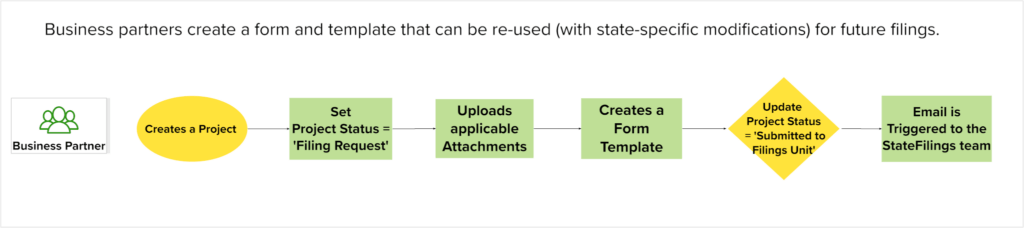
Business Partner Creates a Project

Business partners have a designated role with specific permissions in StateFilings.com. Business partners are generally “read-only.” However, they can enter a new project and hand it off to the state filings unit. Business Partners cannot submit filings or add or edit any other data in the system. A business partner-specific view streamlines their ability to monitor multiple project statuses simultaneously.

Adding and Sharing Documents

Next, the business partner can add documents they want to hand off to the state filings unit. Using the project attachments feature enables the uploading of Word and Excel documents, which can be shared and edited by multiple users simultaneously. Business partners can also create a form template in the exact format that a filer would file it.

Sharing a template with business partners eliminates a manual handoff — the state filings unit can apply the template to a filing instead of re-typing the information into the system.

Read more: 5 reasons why state filings are rejected.

A Smooth, Instant Handoff

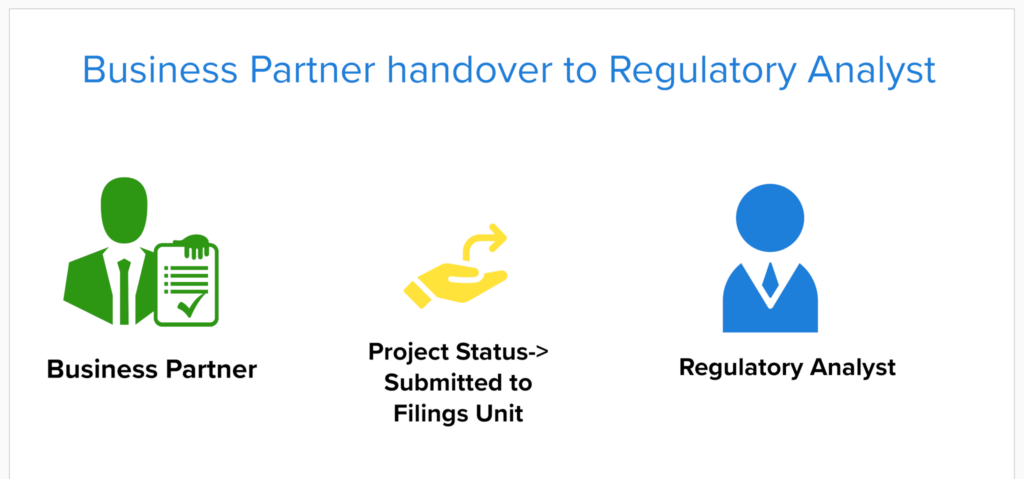
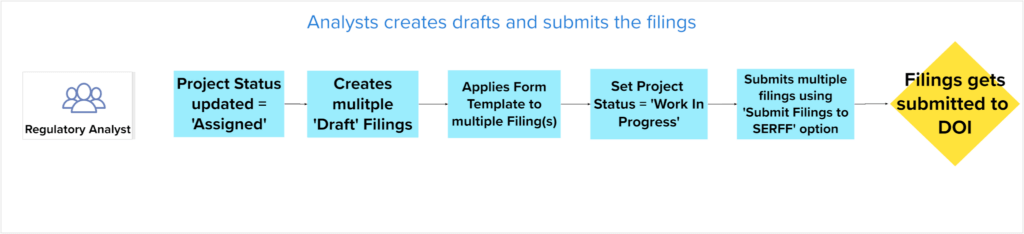
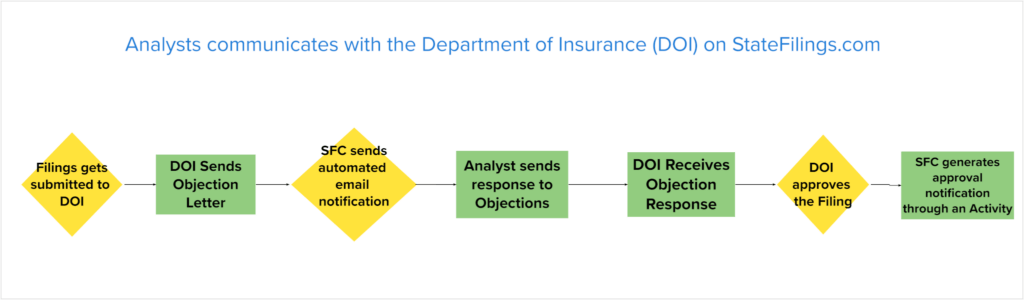
After creating the filing template and attaching relevant documents, the business partner changes the project’s status to “Submitted to Filings Unit.” From this point forward, the business partner can no longer edit the project — they are read-only. The system then automatically fires an email to the state filing unit. A state filing analyst can then accept the project and change its status to “Assigned” to begin their review.

Tracking Work in Progress

Once documentation is finalized, the state filing analyst can create filing drafts and change the project status to “Work in Progress,” indicating the filings have started. The analyst can apply templates to multiple filings simultaneously, saving time by eliminating the need to enter form data manually. The state filings software further streamlines the process by enabling analysts to submit numerous filings to SERFF at once.

Authors can include important information and track the status of each filing in real time. Each submission contains inputs for the following:

  • Filing requirements
  • Project expectations (TOI, form/rate/rule, etc.)
  • Peer review tracking and feedback notes
  • Filing submission dates
  • Objection tracking and corresponding follow-up and due dates
  • Approval communications and dates
  • And more

Automated Objection Handling

When an objection is received, built-in email functionality proactively fires an email to all authors, eliminating the need to proactively monitor SERFF. StateFilings.com stores all past objections, enabling data mining and specific information searches. Two-way integration with SERFF allows authors to issue a response directly from StateFilings.com. Consolidation of all filing-related communications saves time by eliminating the need to track down disparate emails.

Automated Approval Notifications

StateFilings.com automatically notifies authors when SERFF issues an approval. API integration enables companies to update external systems upon SERFF approval, further streamlining the workflow and supporting stakeholder visibility.

Advanced State Filings Software Improves Efficiency

Homegrown systems like Excel, email, and hard drive storage may have been cutting-edge technology in the past but are now outdated. Companies still using these non-centralized technologies compromise efficiency and increase the risk of crucial information falling through the cracks.

StateFilings.com consolidates all data to eliminate manual handoffs and improve tracking visibility. Collaboration in a shared platform enables business partners, analysts, and other stakeholders to keep current on all filings while working together toward a common goal.

See how StateFilings.com can improve your filing process. Contact the experts at Perr&Knight to schedule a state filings software demo.

Six Ways Experts Smooth the Transition to a New Policy Admin System

by Scott Whitaker and Bob Cericola

An aging policy administration system may prohibit your organization from reaching its full potential. Functionality limitations, the inability of your system to keep up with new products and terminated support for older systems all stifle productivity and may force your teams to rely on complicated workarounds that fail to hold up against regulatory scrutiny.

Switching to a new policyholder system creates opportunities to elevate efficiency, improve accuracy, and increase profitability. However, failure to adequately prepare may inversely lead to problems such as inaccurate ratings, incorrect forms or versions of forms, delays in implementation, rework and staff frustration.

Unfortunately, your system vendor’s implementation team may only get you so far. Yes, they possess deep technical expertise and know the software inside and out, but they often lack the depth of knowledge on insurance-related specifics and regulatory requirements that can cause trouble in the future.

Instead, consulting with experienced insurance technology and compliance experts helps your organization sidestep the common pitfalls that delay launch and cause budgets to be exceeded.

At Perr&Knight, we have developed robust operations and technology consulting and product design departments to help insurance companies manage digital transformation more smoothly. Here’s how we help our clients successfully transition to a new policy admin platform.

Clarify system requirements documents

A clear understanding and comprehensive documentation of your filings and implementation rules enables us to develop a plan for the appropriate configuration for your new system or to conduct an internal audit.

The complexity of defining requirements and upfront configurations varies greatly depending on whether you use a rating bureau program, an independent/proprietary program, or a mixture of both (which is common for some commercial programs). Clear and complete documentation defines the impact of forms, rates, and rules to your new product, ensuring the new system functions correctly for your organization.

A precise requirements document means everyone can operate from a shared roadmap. Our insurance technology consulting experts put together a comprehensive requirements document, surfacing and addressing any gaps in the process. The more information we have upfront, the better equipped we are to help you succeed.

Vendor selection consulting

Determining which platform best suits your needs is not always straightforward. Unfortunately, different solutions do not offer apples-to-apples comparisons, leaving you to parse through the details of various platforms to determine if they will be suitable to handle your requirements. What you don’t know that you don’t know may reveal itself after you have selected a vendor and implementation is well underway.

Consulting with insurance technology specialists before deciding on a vendor provides peace of mind. We dig into the details on your behalf, asking vendors pointed questions about your unique business requirements to ensure the proposed solution delivers the highest ROI.

Correct configuration of the new platform

This sounds like a given, but insurance companies often fall into this trap. Third-party vendors hired to manage the transition often lack deep experience in regulatory compliance. Because every state has subtle but important differences in reporting requirements, working with experienced insurance technology consultants ensures your new system is configured to meet compliance standards in every jurisdiction your organization does business.

Too many companies begin implementation and are confronted with a harsh wake-up call when the output is not what they expected from their new policy admin system. But front-end configuration drives the back-end data sets. Therefore, when configuring your new system, we consider the regulatory compliance demands required on the back end. At Perr&Knight, we have extensive forms, rate, rule, and regulatory compliance knowledge and the technical expertise to ensure your output is accurate.

Rating bureau data extracts that are mismatched with expectations are one of the signs of a problem with the new system. Unfortunately, we have seen these errors take insurance companies by surprise when suddenly facing a complaint, data call, or other regulatory inquiry. Of course, reactively remedying misalignment is always possible and often increases costs and delays implementation. Being proactive is preferable, more economical, and allows for a smoother and more timely implementation.

Make sure data is compliant before migrating to the new system

The data you input into your new platform has significant downstream implications. Data input into the policy system feeds forms, claims, statistical reporting, and so on. Inaccuracies in your input can quickly cause data drift that will negatively impact reporting, exposing your organization to increased regulatory attention, especially if the state(s) where you operate issue a data call or request for more information.

Too many companies shift their data over to a new platform without taking the time to determine whether their data is still “good quality.” Taking the time to make sure your input is compliant before migration saves the expensive time drain of trying to clean up data after the transition. Our insurance data specialists can conduct a full audit of your data to evaluate compliance before migrating to your new system.

Schedule a mock market conduct exam

With so many variables in play, a current assessment ensures your existing policy admin system and data are correct and ready for your new system. As part of our Compliance Operations Assessment & Training (COAT) services, Perr&Knight’s compliance experts evaluate rates, rules and forms produced from the current system.

Determining whether your existing policy admin system is accurate before switching to a new platform is a small upfront investment that pays off significantly down the line. This assessment protects you from unplanned and expensive updates to your new system, after all your data has been input and policies have been issued. In addition, it reduces the likelihood of consumer impact (e.g., confidence), unnecessary financial impact (e.g., interest due) and brand reputational harm.

Get ahead of the issues by partnering with experts

Trusting insurance technology experts like Perr&Knight during the planning phase is the most cost-effective way to manage a successful transition. Not only can we surface and address your current platform’s shortcomings, but we can also outline a plan to correctly configure your new system and ensure your existing data is clean and compliant before migration. That said, if you find yourself facing unexpected difficulties at any time during an implementation, we can always apply our insurance-specific technology expertise to help you get back on track quickly and cost-effectively.

Switching to a new policy admin system will always be complicated but partnering with experts means it doesn’t have to be a headache.

Contact the insurance operations and technology specialists at Perr&Knight today to discuss how we can help you make change more manageable.

Why Businesses Today Are Turning to Captive Insurance

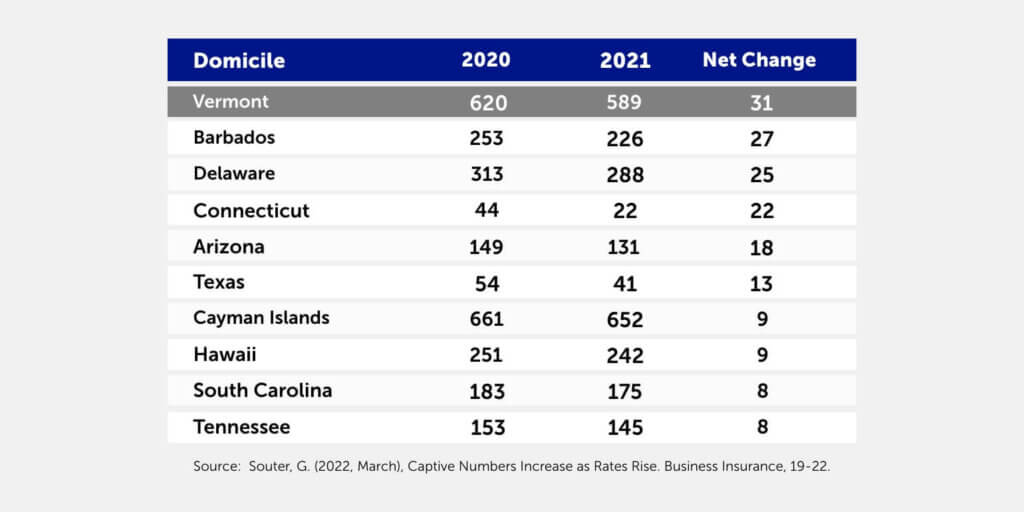
States throughout the US are seeing the number of captive formations skyrocket compared to the past. The 2021 year showed significant increases in the world’s largest captive domiciles. The number of Vermont-licensed captives grew by 31 in 2021, the largest net gain (new captives less dissolved captives) in the domicile’s long history.  The table below shows the  10 domiciles with the largest gains over the 2021 year.

Two key trends in the current hard-market cycle are driving up the number of captive formations: (1) demand for cyber insurance; and (2) climate changes that have steadily driven up property premiums.

As times change, more businesses recognize the value of captive ownership. If your company has never considered self-insurance through captive insurance, now may be the time.

Cyber insurance has become a must-have protection for today’s businesses

Cyber insurance continues to be a hot topic in the industry. As malicious actors become more organized and their attacks more sophisticated, companies without cyber insurance are at risk for potentially devastating ransomware ambushes. Large companies and government entities have been bolstering their cybersecurity protections and can afford to pay cybersecurity analysts, an increasingly scarce resource, making it more challenging for hackers to hijack their data. As a result, bad actors are turning to easier targets: schools and universities, small- and medium-sized businesses, municipalities, and other organizations less equipped to mount a strong defense.

Organizations that previously felt they weren’t significant enough to warrant hacker attention are now prime targets.

As cyber premiums rise, more companies are self-insuring

Cyber insurance premiums nearly doubled industrywide in 2021, and the increases have continued through the first quarter of 2022. Organizations waking up to the need for cyber insurance are facing a catch-22 – they know they need it—but it’s costly.

Companies are forming captives or adding captive insurance to their plans to manage the high cost of cyber insurance premiums. But businesses that have never licensed a captive are often unsure where to begin. Speaking to the experienced actuaries at Perr&Knight is a great start. We’re available to answer questions and provide support through the process of obtaining a captive license.

Lack of historical data for cyber insurance

For companies that already have a captive in place and want to add cyber insurance, our actuarial consulting teams can help with this.

When adding coverage to a captive, companies must provide a business plan amendment to captive regulators, including estimated captive premiums. However, because cyber insurance is so new, the availability of historical data creates challenges determining premiums for this coverage.

Again, this is where working with experienced partners like Perr&Knight is advantageous. We have developed proven methods for estimating captive premiums based on decades of actuarial consulting expertise.

High property premiums lead to more captive formations

Property insurance is getting hit from multiple angles.  Climate change is increasing the number of weather-related property claims. Tornadoes, floods, wildfires, and other significant weather incidents are happening with greater frequency and intensity—and in never-before-seen areas. These catastrophic events continue to drive the hard market, resulting in insurance affordability and availability issues for many companies.

Additionally, regions throughout the nation are experiencing a runup in insured property values. If a business hasn’t had an appraisal in a decade, they may suddenly find themselves paying substantially higher premium based on their property’s amended value.

Captive insurance can mitigate the affordability problem, which is why more businesses opt to self-insure with a captive.

A pre-feasibility study provides direction

Conducting a pre-feasibility study with an experienced actuarial consulting partner can help determine whether captive formation makes sense for your organization.

At Perr&Knight, we have developed methodologies to produce accurate pre-feasibility studies that provide insight into whether captive ownership makes sense for your business. A pre-feasibility study is not only a cost-effective means of gathering business intelligence; information contained in the study can serve as the basis for the actuarial feasibility study that captive regulators will require.

As times change, captives are here to stay

As the world shifts around us, companies recognize the potential benefits of captive insurance. If your company is considering captive ownership or is already well down the path of forming a captive, the team at Perr&Knight can answer questions, provide direction, and deliver insight into the best course of action.

Contact the actuarial experts at Perr&Knight to conduct a pre-feasibility study or to discuss captive insurance options for your business.

Managing State Filings Just Got Easier

Updating and tracking filings in the System for Electronic Rates & Forms Filing (SERFF) has always been a tedious, time-consuming process for state filings departments at insurance companies. Manual data entry runs the risk of human error and creates the potential for information loss. Both of which can slow the filing pace or set the whole process back to zero with a disapproval.

When Perr&Knight introduced our proprietary StateFilings.com software in 2015, we knew the ability to submit and track filing information from a single, real-time cloud-based platform would save state filings teams a significant amount of time and guard against the minor errors that can negatively impact approvals. For years, companies were manually downloading filing documents from SERFF, entering the filing details into their state filing management system, and sending out filing status reports to interested parties. Those days are over. All of this has been automated through StateFilings.com. Filings departments have been freed to dedicate more time to addressing DOI requests and objections, which helps speed up the time to approval for filings and has a direct impact on a company’s bottom line.

Two-way communication with SERFF is here

Though the initial version and subsequent updates of StateFilings.com was a massive time-saver and a huge help for state filings departments, there was just one piece missing: the system only worked in one direction. Filings departments could use StateFilings.com to monitor information coming from state Departments of Insurance (DOIs) but initiating new filings and uploading information to SERFF still required lengthy manual processes on SERFF’s cumbersome website. Now, we are excited to say that the 4.0.0 release of StateFilings.com has solved the communication challenge by enabling two-way exchange functionality with SERFF. This update streamlines the filing process for insurance companies even further.

StateFilings.com’s recently launched system upgrade uses a two-way API to push data into SERFF, so users are no longer required to access the SERFF website directly. Instead, the entire scope of state filings management can be handled on a single platform via a streamlined, intuitive interface.

A recap of StateFilings.com’s capabilities

As mentioned above, we developed the StateFilings.com software to accelerate the filing process by streamlining workflows for insurance company state filing departments. Because we used this software internally for many years before licensing it to our clients, we knew the platform provided measurable value.

In place of the time-consuming manual processes most state filing departments relied on, our software harnesses the power of technology to manage and automate many mundane (but crucial) state filings tasks. Here are some of the system’s key features and benefits:

  • A cloud-based system enables 24/7 access
  • User-level security and role-based permissions protect sensitive data
  • Filing management (including status)
  • Objection and response library
  • Forms libraries for document management
  • Real-time information updates

More useful features

This year’s upgrades to StateFilings.com build on all the features and functionality above, further streamlining the filing process. Here’s how:

Work while SERFF is down

Users can continue to access and review filings, even if SERFF experiences problems.

‘Note to Reviewer’ improvements

Users are now able to submit notes to DOI reviewers en masse across multiple filings and projects. Editable temple language ensures consistency and cuts down on time spent drafting emails.

Filing cloning ability

Users can create a single countrywide draft and with one “save-as” clone for all 50 states, instead of one by one. When submitting to more than one state, generating multiple clones of one filing with a single click eliminates the repetitive process of filing initiation.

Scheduled item template enhancements

Create and update your scheduled item templates for each project and then save time by applying a template to multiple filings at once instead of having to import the template into each individual filing.

Developed specifically for insurance companies

The SERFF system was a major industry breakthrough for insurance companies who were accustomed to filing paperwork via mail or fax. However, as times have changed, state filings departments have increased the demand for a streamlined, user-friendly experience that mimics many of the other digital tools in the modern office suite.

We applied our decades of experience providing insurance support services for products in every line of business to develop a straightforward but powerful tool based on the realities of companies’ state filing department workflows.

The updated StateFilings.com is the latest advancement to accelerate the filing process, enabling insurance companies to be more efficient with their time and more cost-effective overall.

Interested in learning more about what StateFilings.com can do for your business? Schedule a demo today.

How Perr&Knight Defends Your Data

Authors: Tigran Karsian and Dana Pagliarulo, PMP, PMI-ACP

Data security has always been essential, but recent spikes in ransomware and public data dumps of sensitive information are a rising threat. Failure to control data can expose insurers to stiff penalties from regulators, compromise a company’s hard-earned reputation, or stop business in its tracks.

Unfortunately, securing internal systems is only half the battle. Most insurance companies partner with third-party providers for various business operations. Failure on their part to uphold high information security standards could cost your company dearly.

Security risks come in many forms, some more obvious than others. Accidental exposure of protected data, phishing, and other social engineering attacks, malicious and non-malicious insider attacks, ransomware, and data loss during a cloud transition are all ways sensitive company data could become compromised.

According to the Ponemon Institute, the average cost of a data breach in the United States in 2020 was $8.6 million. But data breaches do more than cost money—they have the potential to do major damage to a company’s reputation, workflow, and morale.

At Perr&Knight, “data security” is more than a talking point. It’s an essential part of how we provide superior service to our clients. Here are some of the ways we elevate the standard for data security to defend our clients.

SOC 2® Type 2 Certification

Our SOC 2 type 2 certification shows our clients we have established clear protocols for protecting their data and we continually live up to our own high standards.

Developed by the American Institute of CPAs (AICPA), SOC 2 outlines criteria for managing customer data based on five “trust service principles”: security, availability, processing integrity, confidentiality, and privacy.

Type 2 certification is an internal controls report capturing how we safeguard customer data and how well our controls operate in practice. SOC 2 type 2 certification requires outlining all our data security processes, including data storage, log-in access, credentialing processes, data transfer protocols, and more. Our SOC 2 reporting process covers all internal policies as well as how we manage data in our proprietary insurance support software, including StateFilings.com, StatReporter, and License Reporter.

We then produce documentation verifying we have achieved these standards upon annual audit, conducted by a qualified third party. In contrast to SOC 2 type 1 reporting which is only done once, type 2 requires annual review.

Network Monitoring by Crowdstrike

Our network is protected by Crowdstrike, an industry leader in monitoring and blocking malicious actors. Unlike automated or semi-automated systems, Crowdstrike’s service agreement includes monitoring by experienced network operation center (NOC) analysts. This is significant because humans are better able to distinguish traffic anomalies than software-only solutions, reducing the risk of a threat slipping through the cracks.

Proactive Penetration Testing

A network is only as strong as its ability to withstand attack—and it’s impossible to tell how network security will hold up unless an attack takes place. We proactively attempt to penetrate our own network defenses to reveal vulnerabilities before we find ourselves in a real-world data security emergency.

Working with Trustwave for network penetration testing and Elliot Davis for application penetration testing, we attempt to “hack” our own system on two fronts: from outside the organization and within the company. Separation of sensitive systems ensures data is partitioned and protected should a breach ever occur in one aspect of the organization.

By “pen testing” our applications, such as our industry-leading StateFilings.com app, we ensure our entire suite of technologies is robust enough to withstand brute force attacks or any other attempts to gain unauthorized access.

Exceeding Client Expectations

During decades of serving insurance companies of all sizes in all lines of business, Perr&Knight has worked with every type of organization, from newly-minted InsurTech start-ups to carriers with long histories. Each of these organizations has a different type and depth of data security needs.

In fact, top 10 insurance client security audits are often more intense than even SOC 2 type 2 audits, but Perr&Knight passes with flying colors every time. In many ways, our clients’ questionnaires mimic SOC 2 audits. As a result, we continually re-evaluate our security processes, adjusting our policies to ensure we stay ahead of our clients’ requirements.

A Rigorous Process—But Worth It

Perr&Knight dedicates extensive resources to data security and ensuring we live up to our own high standards. Our clients trust us with their data and we take that responsibility seriously. Other companies may do the bare minimum, which is technically sufficient, but the disaster resulting from a breach makes cutting corners unacceptable. We invest heavily in maintaining strict processes and top-tier technology, but no price is too high for peace of mind.

Work with the leaders in actuarial consulting and insurance operations consulting. Contact Perr&Knight today.

On-Demand Insurance: Insurance for the Sharing and Gig Economies

On-demand insurance is a rapidly growing segment of the insurance market, providing policyholders with many benefits over the traditional insurance model. It can be purchased without directly interacting with a carrier representative, broker, or agent. While on-demand insurance is still new and a small segment of the insurance market, a study by Acumen Research and Consulting estimates the market to grow by nearly 30% by 2026 (1).

ADVANTAGES OVER TRADITIONAL INSURANCE

According to our insurance product development team, there are numerous advantages that on-demand insurance products have over traditional insurance:

  • Convenience: The application process for on-demand products is typically through a mobile or web application with an easy-to-understand interface, minimal number of questions, and the ability to tailor the coverage to a policyholder’s needs. Traditional insurance often involves lengthy interactions with carrier underwriters, agents, or brokers, which could involve protracted and complicated paperwork. More sophisticated on-demand products can obtain an applicant’s driving or claims history and auto-complete many data questions, further easing the application process for the customer.
  • Control: An on-demand policyholder can change the terms of their policy, add or remove coverages, and make other changes through their mobile or web application without having to make time-consuming and inconvenient calls to an underwriter, broker or agent. More sophisticated on-demand products provide many coverage customization options, putting powerful control of the coverage into the hands of the policyholder.
  • Instant Access: On-demand insurance coverage can be applied for and turned on in minutes. This is a big advantage in today’s economy where consumers are used to instant access (streamed music and video, same-day or one-day shipping, etc.).
  • Claims Handling: Claims can often be filed through a mobile or web application instead of having to contact a claims adjuster, adding further convenience and time savings.
  • Expense Savings: Commissions, brokerage costs, and other acquisition expenses are often lower due to the application process being handled through a mobile or web application. Automating the application and claims handling process can also lower the number of underwriters and claims adjusters needed and removes the need for additional paperwork. These costs savings can be passed onto the policyholders through lower premiums.
  • Usage and Need Based Coverage: Many on-demand products are offered on a short-term basis, from as short as one hour to several months, depending on when the policyholder needs coverage. Often, the policyholder can pause and then reactivate their policies to provide coverage only when they need it. Telematics allows for rating of auto insurance based on the actual miles driven. These features are important to gig economy workers who don’t need full coverage over an entire year, instead only needing coverages when they have a project or gig. Other examples of usage and need based coverages include travel or event insurance, with coverages purchased for a single trip or event.
  • Continuous Underwriting: Many on-demand products feature continuously updated pricing and risk profiles using real time data. Examples include usage base auto insurance using telematics, travel insurance using flight and weather data, and homeowners insurance using data from Internet of Things (IoT) devices.
  • Providing Coverage for Gaps in Insurance: On-demand insurance products can provide coverage for gaps in traditional insurance policies. For example, homeowners policies do not typically cover damages when a property is rented to others (Airbnb, Homestay). Personal auto policies don’t cover “business use” of covered vehicles. On demand insurance products can help provide coverages in both these instances and are especially suited to fill in these gaps on a usage and needs basis.

DISADVANTAGES OF ON-DEMAND INSURANCE

Of course, in our experience with insurance product development, we know there are also potential downsides and difficulties with products in this emerging market:

  • Moral Hazard: Since the application process is typically through a mobile or web application, it is difficult to audit the applicant responses for accuracy. Applicants can answer questions dishonestly in order to pay a cheaper premium. Insurers need to create better verification and auditing systems in order to ensure that risks are being priced appropriately.
  • Fraudulent Claims: Customers can potentially purchase on-demand coverage after the actual loss or damage has taken place and make a fraudulent claim that the damage took place after they turned on their coverage. Products that allow pausing and unpausing of coverages are especially susceptible to this risk.
  • Concentrated Exposure: On-demand policies will be purchased or turned on before a work shift or project so the exposure is highly concentrated for the policy term, in comparison to a standard annual policy that doesn’t allow pausing of coverage. Higher rates during usage should be charged to ensure that the premium collected adequately covers the concentrated risk.
  • Adverse Selection: Underwriting standards and knock-out questions are important for on-demand products. Less control over the underwriting process, with minimal ability to audit and review the applicant, can lead to riskier insureds being able to obtain on-demand coverage when they haven’t been able to obtain coverage in the standard market.
  • Regulatory Difficulties: On-demand programs have unique rating, form, and other program features that are different than the products that state insurance departments are used to reviewing. For example, short-term on-demand programs often file leveraged rating factors to provide higher premium for concentrated short-term coverages. Mobile and web applications require filing snapshots of each possible screen. Continuous and real-time pricing based on telematics, IoT devices or real-time travel data are difficult to support to the black-box nature of the technologies. This can result in a more difficult path to approval.

CURRENT ON-DEMAND PROGRAMS

Numerous on-demand insurance products are already available in many different lines of business, including:

  • Metromile offers personal auto coverage for a low monthly rate plus a per miles driven charge, tracked by telematics. Coverage can be switched on and off through the mobile application.
  • Thimble offers commercial general liability, miscellaneous professional liability, and inland marine coverages on a short-term, episodic basis. They allow their liability coverages to be paused and reactivated by the policyholders, through their mobile and web application. Thimble also provides coverage for drone/unmanned aerial vehicles liability insurance on an episodic basis. They have recently started offering episodic commercial property and event insurance in select states.
  • Cuuva is a United Kingdoms based insurer that offers personal auto insurance from 1 hour to 28 days in length.
  • Spot offers $20,000 of accidental injury coverage on a per month, subscription basis. This coverage can provided as a supplemental coverage to a traditional health insurance policy or can be the primary coverage for the roughly 30 million people without comprehensive healthcare coverage.
  • Flock provides drone/unmanned aerial vehicles liability and physical damage insurance coverage on an hourly, monthly, or per drone flight basis.
  • Surround offers Starter Pack insurance which includes bundled non-owned auto, renters, and miscellaneous professional liability coverage on a monthly basis, $60 per month. The products are designed for freelancers and other self-employed working professionals.
  • Digital Risks provides various business insurance coverages for small businesses, with a focus on digital assets, on an on-demand basis. Coverages are paid on a monthly basis. Available coverages include business owners insurance, professional liability and directors and officers liability.
  • Bind provides on-demand health insurance. The coverage options can be changed through the mobile application, including activating coverage during the year for less common, plannable treatments as needed.
  • Tapoly offers on-demand insurance coverage for small businesses, sole traders, freelancers, and the self-employed. Coverage options include professional liability, cyber liability, business owners property and liability, and directors and officers liability.
  • Duuo offers commercial general liability coverage on a daily basis, aimed at gig economy workers.
Perr & Knight has extensive experience assisting on-demand insurers with insurance product development. We have prepared and submitted filings resulting in the approval of many innovative on-demand programs across the United States. Contact us for assistance with your program.

[1] https://www.acumenresearchandconsulting.com/usage-based-insurance-market

Key Things to Know Before Getting Into the Insurance Business

Authors: Mark Nawrath, PMP, MBA, and Dean Ferdico
Today’s technology advancements have the potential to transform businesses across industries. Aging systems and increased demand for new and innovative products mean insurance is ripe for disruption, but new solutions are not always as easy to implement as they may seem. Insurance is both complex and highly regulated: a double hit for Insurtech or non-insurance companies looking to break into the space. That said, there are endless opportunities for your company to make major waves in the industry…if you take a careful approach.
Based on our decades of insurance consulting along with our experience helping numerous Insurtech startups over the last several years, here’s what you should know as you break into the insurance market.

The insurance industry is highly regulated

Many of today’s Insurtech companies emerge from the finance world, where modern technology has transformed everything from customer service to the nature of banking itself. While U.S. banking must comply with a single federal charter, insurance products are subject to disparate rules in 51 jurisdictions, multiplied by 20 to 30 lines of business that each has its own individual coverages. The number of details required for each product filing can be staggering and small errors have the potential to stall the filing on the path-to-market.
Partnering with a seasoned insurance technology consulting company with state filings experts enables you to achieve a clear roadmap of what to expect, potential pitfalls, and areas to consider before you get too far along in the product development process. Experienced partners will provide you with a clear understanding of the playing field and help you draft a realistic strategy for rolling out your product.

Add insurance executives to your team

State Departments of Insurance (DOIs) look favorably upon companies with proven histories in insurance. They have no time to teach inexperienced technology companies or non-insurance companies the ins and outs of creating a compliant filing. Bringing a seasoned insurance executive onto your team – and partnering with proven insurance consultants – helps sidestep avoidable regulatory pitfalls and adds instant credibility to your organization in the eyes of the regulators. The same also applies when raising capital. Venture capital firms feel more comfortable investing in firms with experienced in-house teams and insurance consulting experts onboard.

Primary insurers are skittish

Around eight years ago, many primary insurance companies started issuing paper to unproven Insurtech companies – a move that ultimately damaged their standing with state DOIs. Since then, primary insurers (as well as reinsurance companies) are more discerning about with whom they will do business. After all, their reputations and licenses are on the line. This is where working with a seasoned insurance technology consulting company with state filings experts pays off. Having insurance consultants on your team to thoroughly review and pressure-test your proof of concept will help you stand out to primary insurers and reinsurance carriers.

Insurance compliance is full of hurdles

Receiving approval from state DOIs and remaining compliant also means your policy, billings, and claims administration systems must all meet regulatory standards. These standards include everything from how your products are priced to how you advertise to consumers to how data must be reported. Some requirement documents are thousands of pages long, a difficult task to manage for teams short on insurance experience.
Whether you are implementing an Insurtech solution or offering ancillary insurance along with your primary service offerings, insurance product development is a tricky process. Even bureau-based products that lean heavily on Insurance Services Office (ISO) or National Council on Compensation Insurance (NCCI) content are extremely complicated to interpret and adopt in a compliant manner. Seasoned insurance consultants like the team at Perr&Knight know this content and the related regulatory requirements inside and out because we work with them daily.
We help new Insurtech and non-insurance companies understand how to consume the content to develop an insurance product, how to structure the content for systems development and testing, and how to implement a compliant operational process from the outset. Building compliant systems and communications from the ground up protect your company from speed to market issues or costly re-work while avoiding potential fines for your carrier partner.

Use professional “matchmakers”

Primary insurance companies and reinsurers have what Insurtech companies and non-insurance companies need: approved licenses from state DOIs and capacity. Insurtech/non-insurance businesses have what primary carriers are looking for: fresh ideas, technologies, and access to new markets. Both must vet one another, a daunting task if neither company can accurately verify the validity of the other party’s credentials.
Experienced insurance consultants like the team at Perr&Knight can provide an insurance-focused perspective to determine whether the partnership will be beneficial for both parties. Evaluations from unbiased insurance professionals can increase your confidence that your prospective partner can deliver.

The future is full of opportunity

Technology and consumer product development move with lightning speed. Insurance, on the other hand, is extremely sluggish. The merging of these complementary industries opens a plethora of opportunities for proactive companies, but success is never guaranteed. Re-framing your expectations, working with experts, and adopting a calculated approach to your new insurance offerings are the most effective ways to improve your position. Start exploring “what you know you don’t know” with seasoned insurance experts before you get too far down the road.

Considering launching a new insurance product? Talk to the team at Perr&Knight first.